Chapters
("Greyed-out" titels: envisioned)
Setting the stage
1. The first Märckelbach
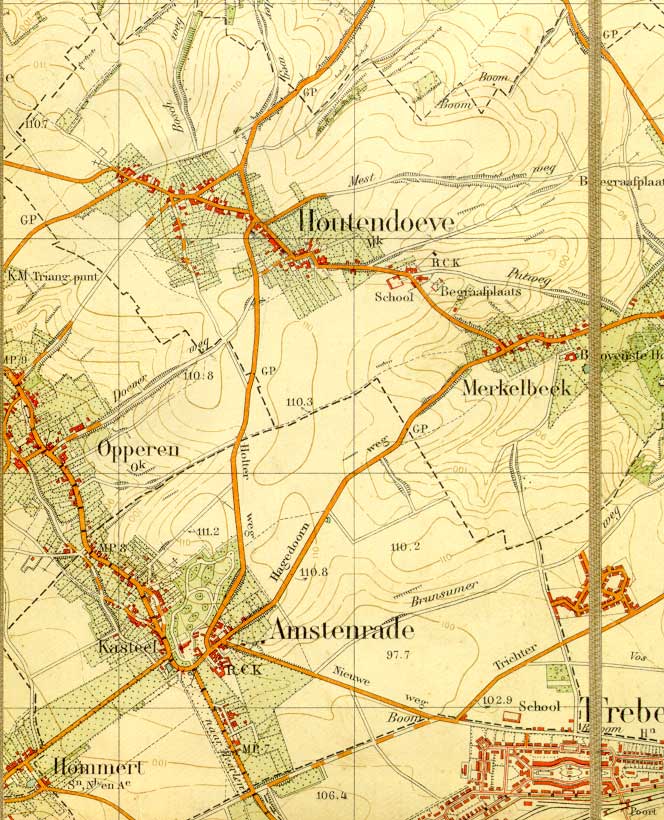
Man von den Duve
To the manor born
From the 10th to 14th century
Kith and kin
Scratching for truth
And guessing some more
Bibliography
Temper of the times
Footnotes
2. Doing the genealogy
3. Bones of contention
4. The elusive "Soldier of Orange"
5. Are we alone?
Legends
6. The legend of Emma's rode
7. The miser and the brave soldier Jan
Genealogy: methods
8. Why look for ancestors?
9. A pedigree chart (for Eric and Adriana)
Parents of our soul
10. Heart of darkness
11. History begins at Sumer
12. Enroute to the Bible
13. Above and beyond
14. Doing as the Romans do
15. Saint Gregory's truth
16. Blessed are the warlike
17. Charlemagne's legacy
18. Medieval feudalism
19. Plain folk in the Middle Ages
Deep roots
20. Nobiscum Deus
21. On to Anstelrade
22. Our heraldry
23. The autumn of the Middle Ages
The first Mer(c)kelbachs
24. Duking it out
25. The Battle of Baesweiler
26. Those powerful "mankamers"
27. The hapless Heynrich
28. Serving the Von Palants
Branching out
29A. Soest
29B. Grenzhausen
29C. Groningen
29D. Maastricht
29E. Thimistre
29F. Strasbourg
29G. Hottorf
29H. Rotterdam
29I. Tienen
29J. Eersel
29K. Hasselt
29L. Lommel (A)
29M. Lommel (B)
29N. Woensel
290. Moerdijk
29P. Lieshout
29Q. Zeelst
29R. Heiden
29S. Heerlen
29T. Wittem
Twigs
30. Fallen by the wayside
Adriaan Märckelbach
31. "Honor and conscience"
Etcetera
32. Reaching beyond the End
33. Of docs, digits, and DNA
34. Explorers of the past
Special thanks for valuable assistance by:
Peter Kreutzwald
Harald Merckelbach
Rudolf Merkelbach
Ger de Vries.
1A
And other valuable help: Michelle Asjes, Peter Bohrer, Margaret ("Margie") Markelbach, Xenia Merkelbach and her immediate relatives. 1B


|
A story has
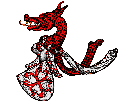
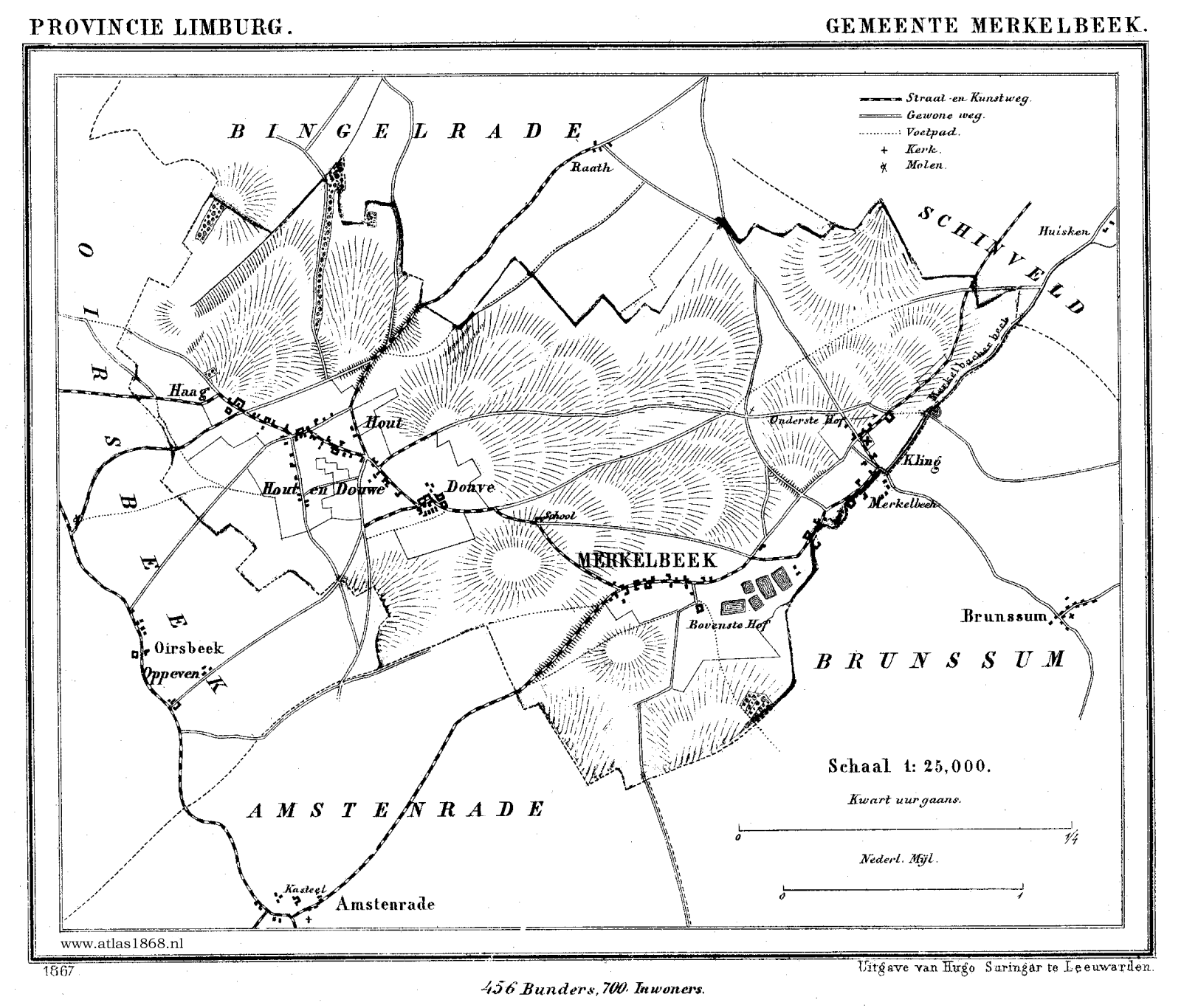
Edited: January 22, 2015 Once upon a time, December 21, 1374 to be exact, one of four sons of the knight Vaes Huyn van Anstenrade, a vassal of Wenceslaus, Duke of Brabant, acquired a fief known as, in Dutch that is, the Bovenste Hof van Merkelbeek. It had belonged to his father. A merkel is a staked-out piece or a measure of land; beek is Dutch for stream, as is the German word Bach. Merkelbeek is said to mean Grensbeek, which translates to bounded by a stream. Merkel is also an old word for the Flemish jay whereas beek might well be related to beak. So, there you have it: the very first paragraph of Our story already is muddled! 3 This Bovenste Hof (Upper Court) consisted of the Douve, which—my guess is—means De Hoeve (the farmstead), and four subsidiary fiefs.* Merkelbeek is the name also of a parish on the banks of a small stream named Merkelbekerbeek, literal translation: Merkelbeek's stream. The parish is said to have evolved since the eighth century.* 3A The beneficiary was Reynart van Austenroede. Austenrode could be taken to mean from the Rode in reference to Amstenrode, his father's abode.* A roede or rode is a piece of land cleared for agriculture. After acquiring his fief, Reynart took the name Reynhart Huyn van Merckelbach or, as it is found written elsewhere, Reynert Huyne von Merkelbeich.* Eventually, the name was shortened to Reynhart van Merckelbach (or variations thereof), pure and simple. The van Merckelbach part served to distinguish this Reynhart from other Reynharts by associating him with a property, a practice that preceded today's mostly legally established custom of inheriting the family name from one's father. The Dutch van (German Von) can be taken to mean of or from. 4 In the year 1381, Wenceslaus acquired the good Valkenburg upon the death of the previous owner, Count Willem II of Jülich (Duke Wenceslaus thereby becoming Count Wenceslaus). A document was then drawn up making Reinhart his vassal. Also that year, a good named Onderste Hof (Lower Court), situated downstream from the Bovenste Hof, went to a Kiedel van Merkelbeeke. The Onderste Hof belonged to a manor named Wijerhof. I don't know whether or not Kiedel was related to Reynhart.* 4A 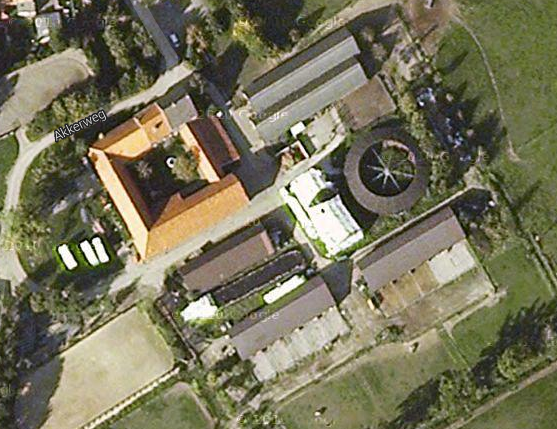 The Bovenste Hof today. The property is owned by the Merkelbeek horsebreeders Guida and Mayke Reumkens.* (From Google Maps.) 4B Jumping from 1374 to 1982, Merkelbeek, situated at 50° 57' N 50° 57' E in the Dutch province of Limburg, becomes merged with the villages Bingelrade, Jabeek, and Schinveld to form a single municipality named Onderbanken (Lower Court), a judicial court. The Bovenste Hof lies along the Mgr Mannestraat and the Akkerweg, on the border of Merkelbeek and the municipality of Brunssum. Its present owners are the horse breeders Guido en Mayke Reumkens. Previously, it was owned by the Dutch government's Department of Agriculture which used it as a model farm for horse-breeding. The name Douve still survives. Below is an 1867 map of Merkelbeek that names both Douve and Bovenste Hof. As for the stream, it is still there, but hardly noticeable. 5 Reynart was born probably around 1330, according to one source, that is; around 1350 according to another.* A notation in Sammlung Oidtmann,* a compendium of genealogical and heraldic information, tells us that Reynart Huyn von Merckelbach took as wife Catharina von Dodenroede [Doenrode].* He thereby acquired, as what we might call a wedding present, half of the Doenrade fief at Oirsbeek; but we better suspect that his father-in-law may not simply have been in a generous frame of mind because acquiring a fief comes with obligations as we may learn from an upcoming chapter about the feudal system. Another compendium, Crassier's Dictionaire historique,* gives the date of the marriage as February 2, 1321, which probably should be read as 1371, handwriting in much of the source documentation being what it is. 7 Reinart had an older brother, Jan Huyn van Amstenrade, who had a son by the same name. To tell them apart, father and son were referred to as de Oude (the Elder) and de Jonge (the Younger). In the year 1371, Reinart took part in a bloody battle fought near Baesweiler between the dukes of Brabant and Jülich. More about this in Chapter 23 except to say that Reinert was accompanied by his young cousin Jan or by his brother or by both.* 8 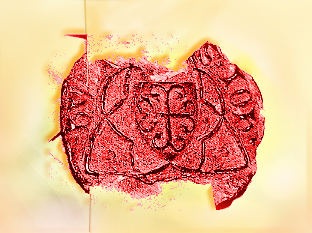 Seal of Johan Huyn van Amstenrade the Elder on a document dated January 25, 1385. (Coloration by Elisabeth G. van Eyken.) 9 Reinart's name has been found on a number of documents. The 1381 document referred to above (par. 4A) recognizes him as man von den Duve mit allen seynenen toebehooren (man of de Douve with all of its belongings).* The archives of the municipality of Sittard contain a document dated January 25, 1385, that has been witnessed by Reinart, his brother, Johann Hune von Amsteroide, as well as by his cousin of identical name, and that bears the seal of the older brother.* This cousin is referred to as his father's squire (shield-bearer), and, considering the stages of a knight's training, we assume that he was not much older than ten years at the time. 10 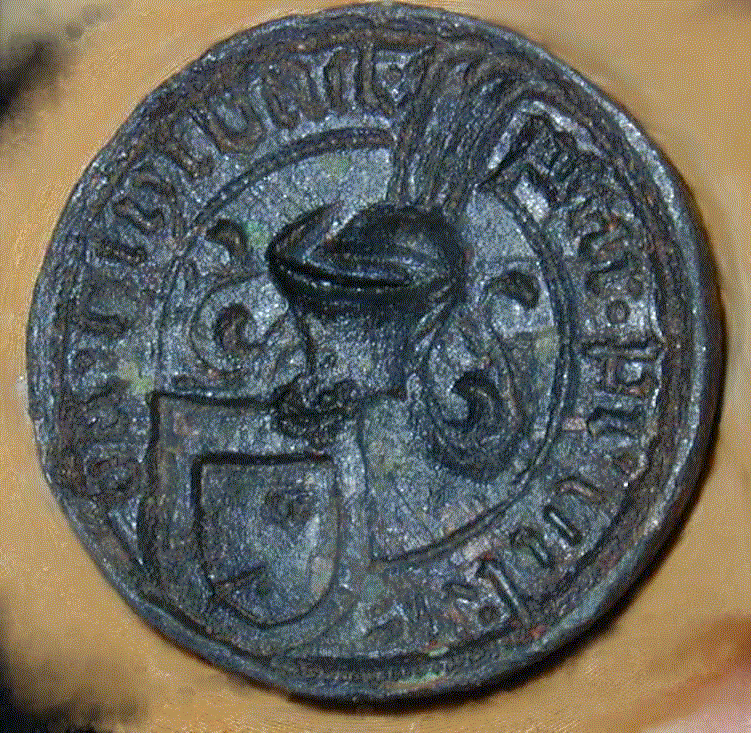 Not long ago, near a place where there used to be a castle, Prickenis, a hobbyist with a metal detector found the silver matrix of a seal. It measured 28 mm across and bears the arms of the family Prick along with the legend: peter•prijck va(n)•geijsbach. Experts dated the seal to early 15th century. (Source.) 11 When we began this project, it was intended to be about people named Merckelbach, but since that time we have learned a fair amount about those who went before them under different names. Hence, attention is paid to forefathers named (Von) Ballenstedt and (van) Anstel who lived during the High Middle Ages. And inasmuch our story is meant to be a social history as well as recognizing that the Roman Catholic church was the institution with the most profound impact on the mindsets of those people, it became felt necessary to devote some chapters on the interaction of secular and ecclesiastical states of affairs from about the year 300 onward. In fact, it is seems hat the right thing to do is to go back even further, to how society appears to have evolved. Well did I realize that medieval thinking was quite different from our own, but hardly did I grasp then just how different! Notes in our Minipedia that will be referred to in due course may come in handy. 12 It is said that Vaes Huyn—also referred to as Servaes van Anstel (named: Hunne) or Sevaes van Anstenrade—was the first to refer to himself as Huyn. Branches of his offspring (Van Amstenrade, Van Merkelbeek, Van Hoensbroek, Van Rivieren, and Van Geleen) were very influential in the region around Sittard in the province of Limburg. In 1391, Servaes's son Reynart, our first Märckelbach, was a schepen (a word variously translated as sheriff, magistrate, and alderman) of Maastricht. 13 We have divided the family tree into three parts, Roots, Trunk, and Branches. For convenience we consider the Von Ballenstedts and Van Anstels as roots of the Merckelbach clan and we shall dip into their history later in our story. This chapter is mainly about the early Merckelbachs who are found in the Trunk. It is a pity that the genealogy here is marred by numerous uncertainties. In the breach, several researchers have come up with their own hypotheses of who begat whom, but that should not be much of an obstacle in working out our clan's social history—or cultural history if you prefer to use that term. The hypotheses I happen to know of are shown in the rubric Trunk. The first one, by De Vries, is linked to a set of rather scanty details about the individuals listed.* 14 The first Merckelbach, Reinart, had a daughter, Bela, who was married twice (at least twice we know of). In 1395, Bela married Goswin von Cortenbach, Statthalter (E: governor, proconsul) of the Valkenburger Mannkammer (a local council of sorts with judicial powers*). On this occasion, Reynart transfers the fief Passerts-Nieuwenhagen to his son-in-law.* 15 In a book published in 1995, family researcher Rudolf Merkelbach asserts that Reinart had, besides his daughter Bela, two or more sons. He referred to them as NN-1 and NN-2. NN is short for nomen nescio (I don't know the name). The older stayed on the Douve; the younger probably moved to Köln (Cologne). This younger son, Rudolf Merkelbach wrote, had two sons himself: Heynrich and Leenart, or Leonard. Heinrich got married twice, the second time, at 60, to a Drüntgen, a daughter of a Peter van Baer. As for Leonard, he is probably the Leonard who was born around 1425 and married Grete (Von) Palant, an illegitimate child of Reinalt (Reinart) Von Palant. This particular Leonard occupies a key position in our story and we shall return to him in Chapter 25, Serving the Von Palants. It needs to be emphasized that in other accounts Leenart [Leonard] is not Heichrich's brother, but Heynrich's son. Things are not always clearly discernible when we peer into the mists of time. 16 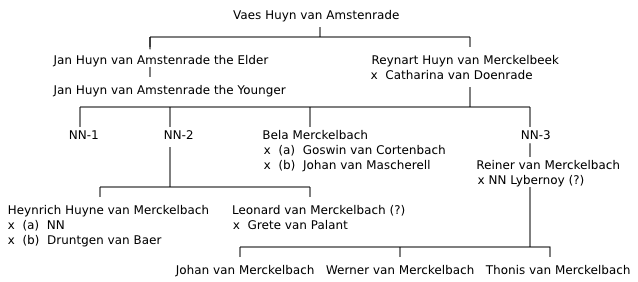 The immediate descendants of Vaes Huyn van Amstenrode according to Rudolf G.F.M. Merkelbach in "De afstammelingen van Gregorius (Goris) Mer(c)kelbach. 350 jaar familiegeschiedenis" (1995). Because of the width of extensive line diagrams, we need follow a different approach for showing family relationships, see Trunk. 17 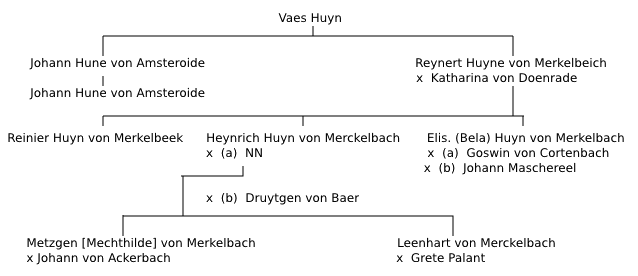 The immediate descendants of Vaes Huyn van Amstenrode according to Max Dechamps, Die Ursprung des Geschlechtes Merckelbach. Die Ursprung, an unpublished manuscript, is an important, but not infallible source about the early Merckelbachs. Whereas the previous chart shows Heinrich von Merckelbach as the grandson of our first Merckelbach, here he is shown as Reinhart's son. 18 Rudolf Merkelbach's book tells us that in the years 1435 and 1442 Heynrich was a schout (dictionary translation: sheriff, bailiff) serving under Werner van Palant, Grete's grandfather. This does not mean that Heynrich did not hold that position during the years in-between, it simply means that for those two years records exist that tell us so explicitly. It also appears from existing documents that Heynrich was not an easy man to get along with for he was involved in several bitter court cases. Mostly these show that his marriage with Drüntgen was not a happy one; we shall go into further detail later, in Chapter 24, The hapless Heynrich. 19 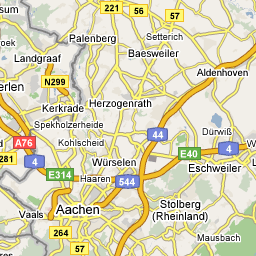 For cities and towns where the Merckelbach family originally used to dwell, click on Google maps. 20 An officially unpublished manuscript by Max Dechamps gives us a fair amount of detail about the early Merckelbachs. I received a portion of it from a Peter Kreutzwald, who himself maintains a website that includes an extensive version of much of the Merckelbach family tree along with a related database. Kreutzwald's genealogy and historical annotations are largely drawn from Deschamps' manuscript, Der Ursprung des Geschlechtes Merckelbach.* The first page of the manuscript mentions a case entered in the records of Cologne dated May 25, 1442 that concerns litigation between Heynrich and a Tilman zom Huetlyn, or Tilman van Hotelen. Most interesting at this point is the list of witnesses who testify to Heynrich's character. They are: (1) Johann dominus in Wynantzroide, who is Johan van Mascherell, the second husband of Heynrich's aunt Bela von Merckelbach*, (2) Johan Hoin to the Broich, Lord at Velleruys and at Plenevaes, and cousin of Heynrich, (3) Johann of Withem, drost of Valkenburg and, according to one of Fahne's family records,* a son of Katharina Hoen zum Broek, and (4) Johann Hoen von Amstenrode, another cousin of Heynrich. I don't know just how far the reach is of the word cousin, but this list does suggest that among Vaes Huyn van Amstenrode's offspring there was a Van Withem and a Van Hoensbroek. 21 A fragment of the family tree found in Trunk also lists a Reiner Merckelbach married to a Lybernoy and three sons. Reiner, whose name shows up in the archives of Maastricht of the year 1434, is, if our genealogy is correct, a grandson of the first Reynart Huyn von Merckelbach. In 1451, those sons, Johan, Werner and Thonis, lived in Eys. Gerard A. Merkelbach (a distant relative of genealogist Rudolf Merkelbach) wrote a paper, Voorlopig overzicht van Het Geslacht Huyn van Amstenrode tot en met de afsplitsing van de zijlinie Huyn van Merckelbach in which he defends his opinion that this threesome were Reynart Huyn van Merckelbach's only male descendants in the southern part of the Dutch province of Limburg. But another amateur genealogist, Ger de Vries, arranged things differently as shown here. All of which goes to show just how murky our genealogy is around this time. 22 Bibliography
|
There are numerous variations of the name. Most common are Merckelbach and Merkelbach. Two others are, in the order of appearance in this story, Märckelbach and Merkelbeich. Still others are Merkelbag, Merckelbagh, Marckelbach, Merkenbach, Mer(c)kelenbach, Markilbach, Merkelback, Merkelbacq, Merkelabach, and others still. Near the end of the branch of our personal interest we have a father, Adriaan, and three daughters, all of whose family names have been officially recorded in the Civil Register of their place of birth, Bussum in the Dutch province of North Holland, as Märchelbach even though they themselves not ever deviated from using the name Märckelbach. The father inherited a printing and publishing business named De Wed. G.M. Märckelbach N.V. * (return) fn1 A fief is a form of loan, usually of land, estates, or buildings. I imagine that Bovenhof (boven, E. upper) is so named because it has subsidiary fiefs, among them Neuenhof, a.k.a. Nieuwenhof, Nuwenhoff, Nova villa, Nova curia, Curtis nova. The other subsidiary fiefs were: "De groote Tiende van Nuth," and manors belonging to Dieboutz, resp. Jan van Nuth. De Groote Tiende van Nuth was not an immoveable property, but a right, the right to one tenth of the income of the inhabitants of Nuth. More precisely, the Merkelbeek estate was a fief belonging to Valkenburg which itself was acquired by the Duke of Brabant in 1378. (Ref 1, Ref 2). Creating a fief from an existing one is termed infeudation. More about vassals and fiefs in Chapter 18, Medieval feudalism. * (return) fn2 A record of the year 1234 mentions a parish named Merkelbeek. Merkelbeek and its immediate surrounding became an independent town in 1796 during a period that feudalism became officially abolished (Ref). * (return) fn3 The village Amstenrode (in the local dialect Austroa) may for some time have been called Ostenrode, which sounds about the same as Austenroede (Ref). * (return) fn4 References: Heren van Valkenburg, Bovenste Hof, Onderste Hof. * (return) fn4A Reynart van Merckelbach is the name found in R.G.F.M. Merkelbach, De afstammelingen van Gregorius (Goris) Mer(c)kelbach, p. 3. The name Reynert Huyne von Merkelbeich is found in Max Dechamps (1911–1985), Der Ursprung des Geschlechtes Merckelbach, p. 1. This chapter is just about entirely based on these two sources. They do diverge on many a detail as indeed they are bound to. Notably, it is common that original records consulted by historians give different spellings of names; after all, record keepers either copied names or spelled them by how they sounded. Accordingly, this history does not even begin to aim for a consistent spelling of names. * (return) fn5 The Dutch telephone book for the year 2008 lists: Reumkens G A J, Akkerweg 5/A, 6441 LG Brunssum, Tel. 045 5257273. * (return) fn6 A difference of some 20 years becomes quite important as our story unfolds, in Chapter 24, The hapless Heynrich. * (return) fn7 Sammlung means collection. Ernst von Oidtman (1854–1937) was a Prussian officer highly regarded for his extensive genealogical research of over 230 mighty families in Rhineland (Ref). Oidtman recorded that in 1429, after his father's death, the knight Johann Maschereil, Herr zu Herwinandsrode, married Bela, the widow of Goswin von Cortenbach in Helmont. Bela was a daughter of Reynart Huyn von Merckelbach and Catharina von Dodenroede [Doenrode]. Johann died near 1456. His daughter Catharina became the wife of Goedert von Vlodorf, Herr zu Leuth. (Ref). * (return) fn8 A genealogy assembled by Ger de Vries gives the name Catharina van Dobbelstein, ref. The van (German Von) in a family name points to a place of present or former residence. We should not be surprised, therefore, that a single person may be referred to by two different names. To (German: Zu) means that the name holder still is in possession of the named good. * (return) fn9 Louis Baron de Crassier, Dictionnaire historique du Limbourg neerlandais, de la période féodale a nos jours or Valkenburg aan de Geul in Dictionnaire historique du Limbourg Néerlandais de la période féodale à nos jours. (Amazon.com reported that the book is currently not available -Feb. 13, 2015). * (return) fn10 R.G.F.M. Merkelbach uses the word oldest, not older. Reynart had more than one brother older than he, cf Scenarios 1 and 2 in the first part of Trunk. * (return) fn11 Rudolf Merkelbach's De afstammelingen van Gregorius (Goris) Mer(c)kelbach mentions it was the son who accompanied him; Max Dechamps, in his Der Ursprung des Geschlechtes Merckelbach, states that it was Reynart's brother, De Oude, not his brother's son, De Jonge, who participated in the battle. Yet another source puts all three on the scene: "The oldest documented mention [of the family Huyn] dates from the 14th century. After the 1371 Battle of Baesweiler, a Johann der Ältere and a Johann der Jüngere (father and son) as well as a Reiner Huyn von Anstenraidt (ancient spelling for the community Amstenraedt), and after their release, used a seal with an "Ankerkreuz" (anchor-cross) showing eight serpent heads. The three family members served in the supply unit of the Drossaard of Valkenburg." * (return) fn12 The word man carried a different meaning in those days than it does today. He was not merely a male person. A man was someone who had assumed obligations in return for a fief, which was a source of income and gave him status. We sense this feudal meaning of the word in such current expressions as "a man's man" (an empowered personal attendant) and "the best man" at a wedding. * (return) fn13 The document they witnessed was an arrangement between Wynrich von Wildroide and Heinrich van dem Berghe that concerned the property of a Dietriech von dem Berghe. Just in case you like to know. * (return) fn14 Living, as I do, far removed from where original source material is found, I cannot very well create hypotheses of my own. Henceforth, I will record various views and point out where I find them to be conflicting, as in Chapter 3, Bones of contention. * (return) fn15 A Mannkammer (D. mankamer) handled the financial and administrative affairs in a lord's relationship with his vassals. It is discussed more fully in Chapter 26. * (return) fn16 In 1394 also, a Petersse van Cortenbach was prioress of the Norbertinessenklooster of Saint-Gerlach in Houthem. The record shows a number of relatives of the Merckelbach family having taken vows to commit themselves to religious life. * (return) fn17 A few years later, I received a complete copy from Prof. Dr. Harald Merckelbach, a contributor to a compendium of the Dutch patriciate. * (return) fn18 Or, as we shall see later, his sister. This is one of the uncertainties that still in need of resolving. * (return) fn19 Found on the internet that Anton Fahne wrote many works about upper-class families. I have not yet zeroed in on the particular volume that contains the information referred to. (Ref). * (return) fn20 |
--
| top of page |
|
Text style:
Navigation through this website is explained in Chapter 2, ¶ 20.
"Funny" purple numbers identify paragraphs, graphics, tables, etc. More about them in Chapters 2 and 3.
The asterisk, *, is a hyperlink to a footnote, and once there, back again to its place in the the main text.
Colophon
Page format: Nov. 22, 2011
Story edit: January 22, 2015
Spell check: February 13, 2015
Tiny prolog added: January 17, 2015
To be checked for timeliness
¶ 5 (…present owners…): Nov. 20, 2011
¶ 23C (…thought today…): Nov. 20, 2011
¶ Footnote 2 refers to Chapter 18, Medieval feudalism.
¶ Footnote 7 and Par. 19 refer to Chapter 26, The Hapless Heinrich
¶ Par. 8 refers to Chapter 23, The Battle of Baesweiler
¶ Footnote 16 refers to Chapter26, Those powerful Mankamers
¶ Par. 16 refers to Chapter 25, Serving the Von Palants
.
Reminders
¶ fn10 (keep looking into Crassier documentation): Feb. 13, 2015
Link check: Feb. 13, 2015
XHTML verify: March 11, 2015
Backups: Nov. 17, 2011
Workshop.
This site is a work in progress and subject to frequent updates, corrections, and revisions!
January 17, 2014
Progress report: Objectives
I'd like to continue writing! But let's be realistic. I am well underway to becoming 88 years of age and hence it must be doubted that I shall ever complete this project, a work I found deserving of much more study and reflection than I had in mind when I started it seven or eight years ago. Having to cope with a memory that by its fading I am bound to slow down considerably. In other words, soon I must leave it to others to continue this project. I am trying to mold this project in a way that other Merckelbachs may adapt this workt to suit their own liking and/or write the histories of the branches they themselves belong to. My own priority is work on the so-named "Maastricht branch," the branch of my father-in-law Adriaan Märckelbach
Currently, I am much preoccupied by why people do what they do and how that why has changed over time. I wish this story to be more than a collection of names of who begot whom; I am attempting to use the genealogy of the Merckelbach family as a leitmotif for a history of thought, or motivation, or culture ... whatever. How did we and the way we are come about? A bit too ambitious probably, but why not give it a try?
March 6, 2012
Progress report: Progress and objectives
Am continuing to improve page design and readability. Letter size and color density ought help guide the eye in distinguishing between main and auxiliary texts. Underlining of words and phrases is strictly reserved for hyperlinking.
The family tree and its branches will all contain the  and
and  icons for moving back and forth between each person's place in the tree format and the database. Occasionally, down arrows are used in a page's list of contents. The underlined asterisk, *, is reserved as a switch to a footnote and from there back to the main text (whereas the plain asterisk, *, serves to indicate date of birth).
I have found about seven to eight thousand mentions of Merckelbachs in the print media and have begun to incorporate them in the database. I am doing this so as to, in my present opinion, best serve as grist for the family's history. They are still left untranslated because that is just too much work for now. For an example of this aspect of the work, look at the database for the Maastricht branch.
Our ultimate objective is to produce a social history of a family with traceable roots going back to before the year 1000. A major emphasis will be on the mindset of the characters as it developed during this time. This requires going back to the roots of myth and religion because, apart from our genetic make-up, they provide the major part of the principles that guide people through life. I like to quote here a paragraph written by the prominent mythologist Joseph Campbell. In 1964, he wrote about the importance of rites:
"The function of ritual, as I understand it, is to give form to human life, not in the way of a mere surface arrangement, but in depth. In ancient times, every social occasion was ritually structured and the sense of depth was rendered through the maintenance of a religious tone. Today, on the other hand, the religious tone is reserved for exceptional, very special 'sacred' occasions. And yet even in the patterns of our secular life, ritual survives. It can be recognized, for example, not only in the decorum of courts and regulations of military life, but also in the manners of people sitting down to table together." (Joseph Campbell, "Myths to live by.")
Footnote
See how it works!*